
The short answer
A heat pump makes sense for many San Jose homes when the air conditioner or furnace is failing, because one system handles both mild winters and hot summers. We check your home's heating and cooling needs, ductwork, and electrical panel first. Then we give you repair and replacement options in writing.
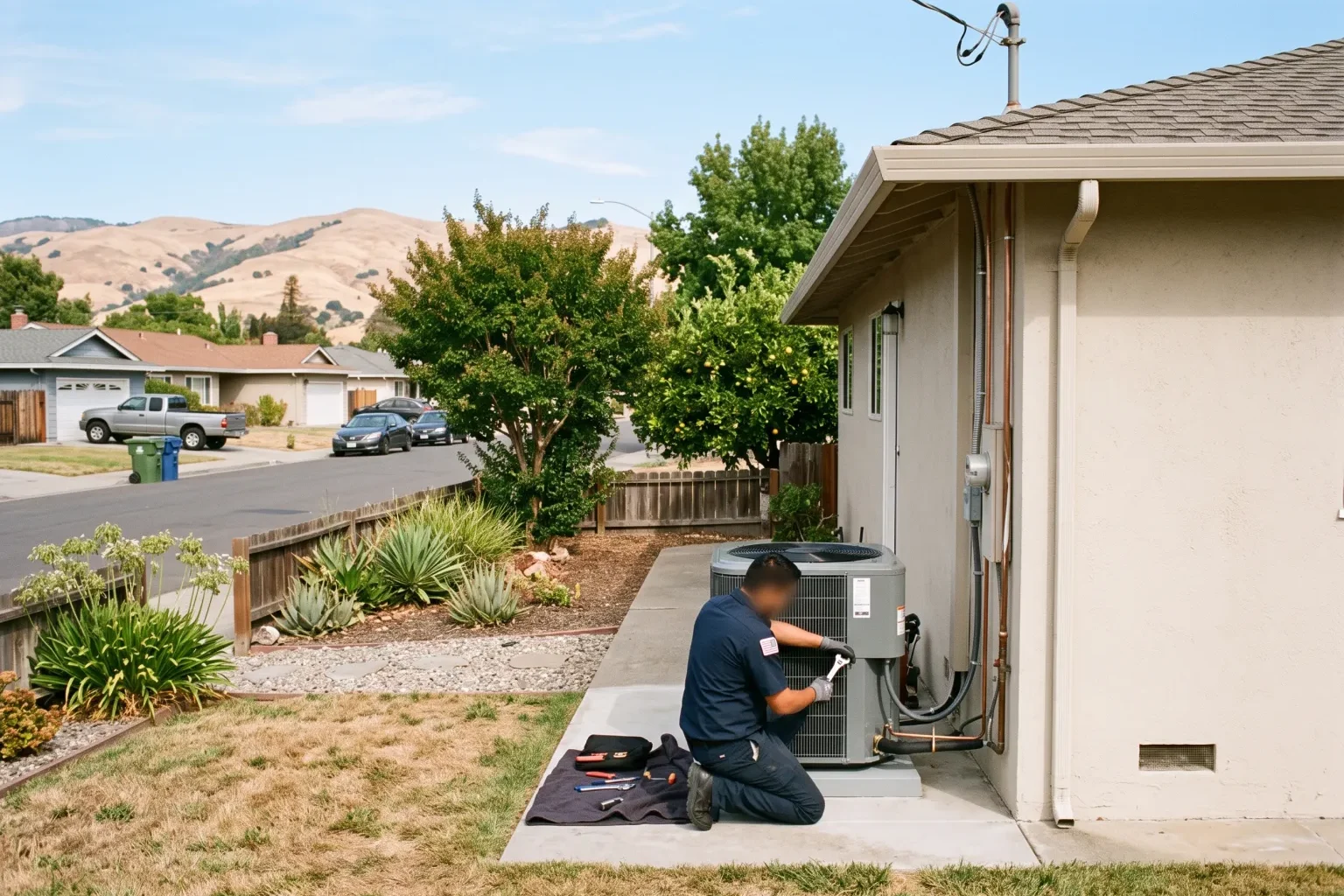
A heat pump heats and cools your home with one system by moving heat instead of burning fuel. In the Santa Clara Valley, where summers are dry and winters are mild and damp, that matches the way most homes use heating and cooling. CoolForce AC Repair installs heat pumps for homeowners in San Jose and nearby cities, whether you're replacing an aging air conditioner, retiring a gas furnace, or trying to fix rooms that never feel right. This page explains how we decide whether a heat pump makes sense for your home, what we look at, and what to expect from start to finish.
Signs It's Time to Consider a Heat Pump
Most homeowners start thinking about a heat pump when something else forces the question. A heat pump isn't the right answer for every home, but these situations are good reasons to get an assessment:
Inland and southern parts of the valley get noticeably hotter in summer than neighborhoods near the Bay. In those areas, cooling capacity often drives the decision as much as heating does.
- Your central air conditioner needs a major repair, such as a failed compressor or a refrigerant leak in the outdoor coil.
- Your gas furnace is old, noisy, short-cycling, or needs repeated repairs.
- Some rooms run hot in summer and cold in winter no matter how you set the thermostat.
- You want air conditioning in a home that has only a furnace or wall heater.
- You're planning a remodel, an addition, or electrical upgrades and want to plan heating and cooling at the same time.
- Your utility bills have gone up even though you haven't changed how you use the system.
What We Check Before Recommending a System
A heat pump has to be sized and matched to your house, not just to the old equipment. Before we recommend anything, we look at:
If your home has no ducts, or the existing ducts can't reasonably be repaired, we'll walk you through ductless mini-split options room by room.
- Heating and cooling load: square footage, insulation, windows, sun exposure, and ceiling height. This keeps the system from being oversized or undersized.
- Ductwork: size, condition, leaks, and whether the existing ducts can deliver the airflow a heat pump needs.
- Electrical service: panel capacity, open breaker space, and the circuit the outdoor unit will need.
- Outdoor unit location: clearance, drainage, noise near bedrooms or neighbors, and access for future service.
- Indoor equipment: whether your current air handler or furnace can be reused or should be replaced.
- Thermostat and controls: whether they work with heat pump operation, including staging and defrost.
Repair, Replace, or Convert
Not every problem calls for a new system. If your current air conditioner or heat pump has a fixable issue, such as a failed capacitor, a clogged drain line, a bad contactor, or a dirty coil, we'll tell you and give you the repair option. Replacement makes more sense when the equipment is near the end of its life, when a major component has failed, or when the same repairs keep coming back.
When you do replace, there are a few common paths. A full heat pump system replaces both the air conditioner and the furnace. A dual-fuel setup pairs a heat pump with your existing gas furnace as backup. Ductless mini-splits work for homes or rooms without usable ducts. We'll explain the tradeoffs of each for your house, including comfort, noise, and how much of your existing equipment can stay.
You don't have to tear out equipment that works. Bay Area Air District appliance rules don't require replacing a working furnace or water heater. They apply only when one fails or is replaced.
Bay Area Rules and Incentives to Know
Under Bay Area Air District Rule 9-4, natural gas furnaces manufactured starting in 2029 must meet a zero-NOx emission standard. In practice, that points homeowners toward heat pumps when a furnace is replaced after that date. If your furnace is aging, it helps to know your options before it fails on a cold night.
A related rule for small water heaters set a zero-NOx date of 2027, but the Air District Board is considering amendments in November 2026 that could delay it. If you're also thinking about your water heater, check the current rule before you make plans.
The federal tax credit for qualifying heat pumps covered systems placed in service before December 31, 2025. It isn't available for new installations after that date. Local programs may still help. BayREN and your local clean energy provider offer heat pump and electrification incentives, but amounts and availability change with each funding cycle. We confirm the current offer before we include it in a quote.
What Affects the Cost of a Heat Pump Installation
We don't quote heat pump installations sight unseen, because the cost depends on your home. The biggest factors are:
You'll get a written quote that lists what's included, so you can compare options side by side.
- System type: ducted, ductless, or dual-fuel.
- The capacity and efficiency level of the equipment you choose.
- Duct repairs, sealing, or new duct runs.
- Electrical work, including a new circuit or a panel upgrade if your current panel can't handle the added load.
- Removal of old equipment and refrigerant recovery.
- Outdoor unit placement, mounting pad or wall bracket, and refrigerant line length.
- Permits and inspections required by your city.
- Incentives available at the time of installation.
How a Heat Pump Installation Visit Works
First visit: a technician walks through your home, checks the current system, takes measurements, inspects the ducts and electrical panel, and asks how you use each room. Afterward, we send a written recommendation with your options.
Installation: we protect your floors, remove the old equipment, set the indoor and outdoor units, run the refrigerant lines and wiring, and connect the thermostat. Straightforward replacements are usually quicker. Jobs that need duct or electrical work take longer, and we'll tell you what to expect before we start.
Before we leave, we run the system in heating and cooling modes and check the refrigerant charge, airflow, and temperatures. We show you how to use the thermostat and change the filter, and we coordinate any inspection your city requires.
Heat Pump Installation by city
- Heat Pump Installation in Campbell
- Heat Pump Installation in Los Gatos
- Heat Pump Installation in Monte Sereno
- Heat Pump Installation in Saratoga
- Heat Pump Installation in Santa Clara
- Heat Pump Installation in Cupertino
- Heat Pump Installation in Sunnyvale
- Heat Pump Installation in Milpitas
- Heat Pump Installation in Los Altos
- Heat Pump Installation in Mountain View
- Heat Pump Installation in Los Altos Hills
- Heat Pump Installation in Scotts Valley