
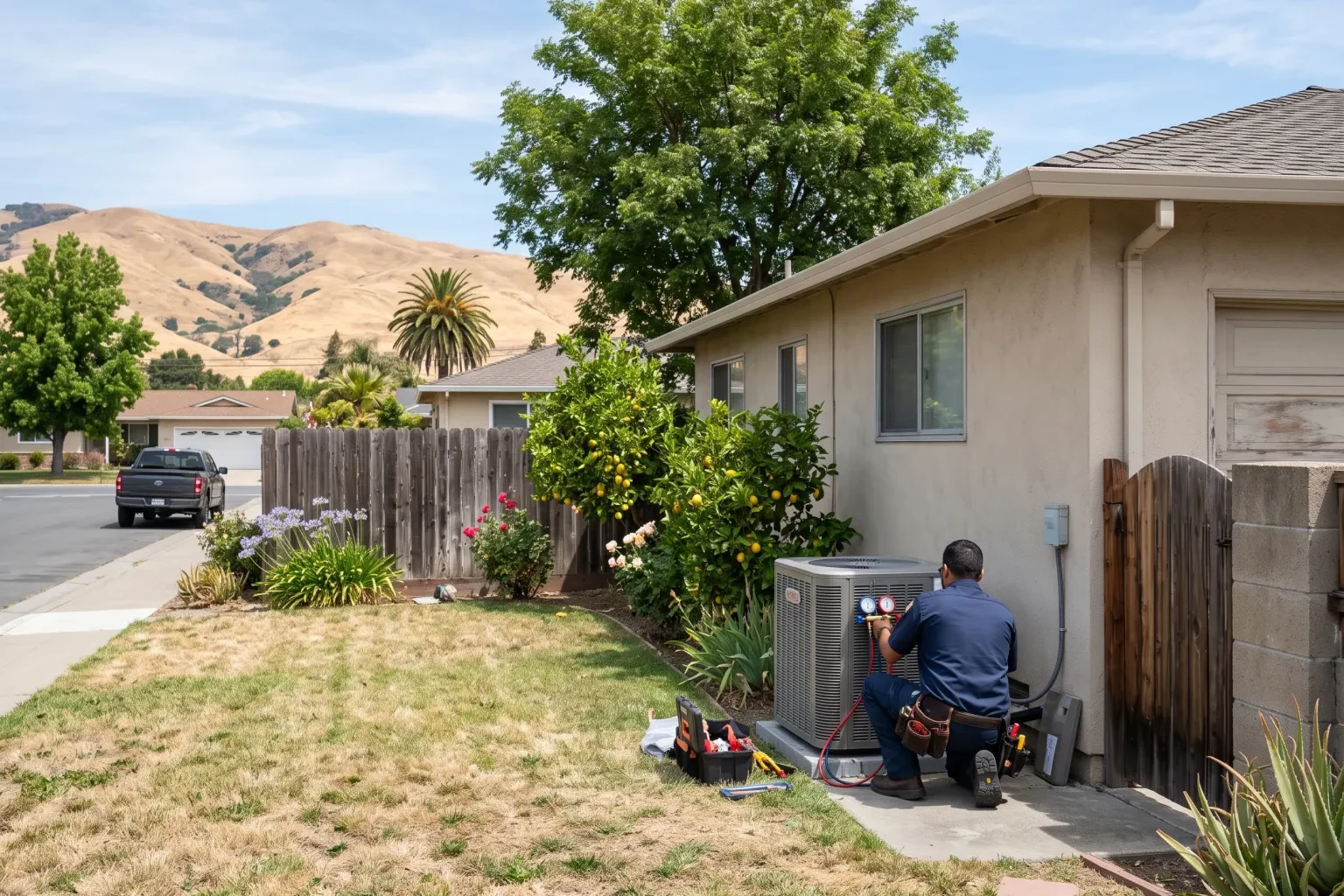
The short answer
If your AC blows warm air, short-cycles, ices up, leaks water, or makes new noises, it likely needs repair. CoolForce AC Repair diagnoses the cause, explains your repair and replacement options, and gives you the price before any work begins.
When your air conditioner quits on a hot afternoon, you want straight answers: what's wrong, what it takes to fix it, and whether it's worth fixing at all. CoolForce AC Repair works on central air conditioners and heat pumps in homes across San Jose and nearby cities, including Santa Clara, Campbell, Milpitas, and Los Gatos. This page covers the warning signs to watch for, what our technicians check, how we think about repair versus replacement, what affects the cost, and what a service visit looks like from your first call to the final test.
Signs your AC needs repair
Santa Clara Valley summers are dry and warm, and inland and southern parts of the valley run noticeably hotter than neighborhoods closer to the Bay. An AC that limps along in early summer can fail outright during a long hot stretch. Catching problems early usually means a simpler repair. Watch for these signs:
If the system is grinding, icing up, or tripping the breaker repeatedly, turn it off until it can be checked. Running a struggling system can turn a small repair into a much larger one.
- Warm or barely cool air coming from the vents
- Weak airflow, even with a clean filter
- Short-cycling, where the system turns on and off every few minutes
- Ice on the refrigerant lines or the indoor coil
- Water pooling near the indoor unit or furnace cabinet
- Grinding, squealing, buzzing, or banging noises
- Burning, musty, or electrical smells when the system runs
- A breaker that trips, or an outdoor unit that hums while the fan won't spin
- Rooms that used to stay comfortable now running several degrees warmer
- Higher electric bills without any change in how you use the AC
What we check during a repair visit
A good repair isn't just swapping the first part that looks worn. Our technician works through the whole system so the fix addresses the cause, not only the symptom. Depending on what you're seeing, that typically includes the items below.
Before any work starts, we explain what we found in plain terms, show you the problem when we can, and tell you what we recommend and why.
- Thermostat settings, wiring, and batteries
- Air filter condition and airflow through return and supply ducts
- Electrical connections, contactor, and capacitor at the outdoor unit
- Condenser fan motor and compressor operation
- Refrigerant pressures and temperatures, and signs of a leak
- Indoor evaporator coil and blower motor
- Condensate drain line, drain pan, and safety float switch
- Outdoor coil cleanliness and clearance around the unit
- Temperature difference between supply and return air
Repair or replace: how we help you decide
Most AC problems are repairable. A failed capacitor, a clogged drain line, or a worn fan motor is usually a straightforward fix, and replacing a whole system over one of those wouldn't make sense. We recommend repair whenever the system is otherwise in reasonable shape.
Replacement starts to make more sense when the system is near the end of its expected life, needs a major component such as a compressor, has a refrigerant leak that keeps coming back, or has needed repeated repairs in recent seasons. Comfort matters too: if some rooms never cool properly, a repair may not solve the underlying problem.
If you're weighing replacement, consider a heat pump, which cools in summer and heats in winter. Under Bay Area Air District rules, natural gas furnaces made from 2029 on must meet a zero-NOx emission standard, which in practice points many homeowners toward heat pumps when a furnace is eventually replaced. Those rules don't require you to replace working equipment; they apply only when a furnace fails or is replaced. Planning your cooling and heating together can keep you from doing the job twice.
On incentives: the federal Energy Efficient Home Improvement Credit (25C) covered qualifying heat pumps placed in service before December 31, 2025, so it isn't available for new installations now. BayREN and your local clean energy provider may offer heat pump and electrification incentives, but amounts and availability change by funding cycle. We confirm the current offer before including it in any quote.
What affects the cost of an AC repair
We can't give a fair number without seeing the system, but these are the factors that move the cost up or down:
You'll get the price for the recommended work before we start, and you decide whether to go ahead.
- Which part failed, from a small electrical component to a compressor
- Whether the part is in stock or needs to be ordered
- Refrigerant type and how much is needed, plus any leak search and repair
- System age, since older units can need harder-to-find parts
- Access, such as an attic air handler or a condenser in a tight side yard
- Whether one problem caused another, like a capacitor failing because of a weak motor
- Timing, including after-hours or urgent visits
How an AC repair visit works
Here's what to expect when you schedule with us:
Before we arrive, it helps to clear a path to the indoor unit and the outdoor condenser, note when the problem started, and check whether the filter is badly clogged. If the system is icing up, turn it off and let it thaw so we can diagnose it properly.
- You tell us what the system is doing, and we set an arrival window.
- The technician asks a few questions, then inspects the thermostat, indoor unit, and outdoor unit.
- We diagnose the cause and explain your options, including repair and, when it's relevant, replacement.
- You approve the work and the price before anything is done.
- We make the repair, then run the system and check temperatures, airflow, and electrical readings.
- We point out anything worth watching, such as a filter that needs changing more often.